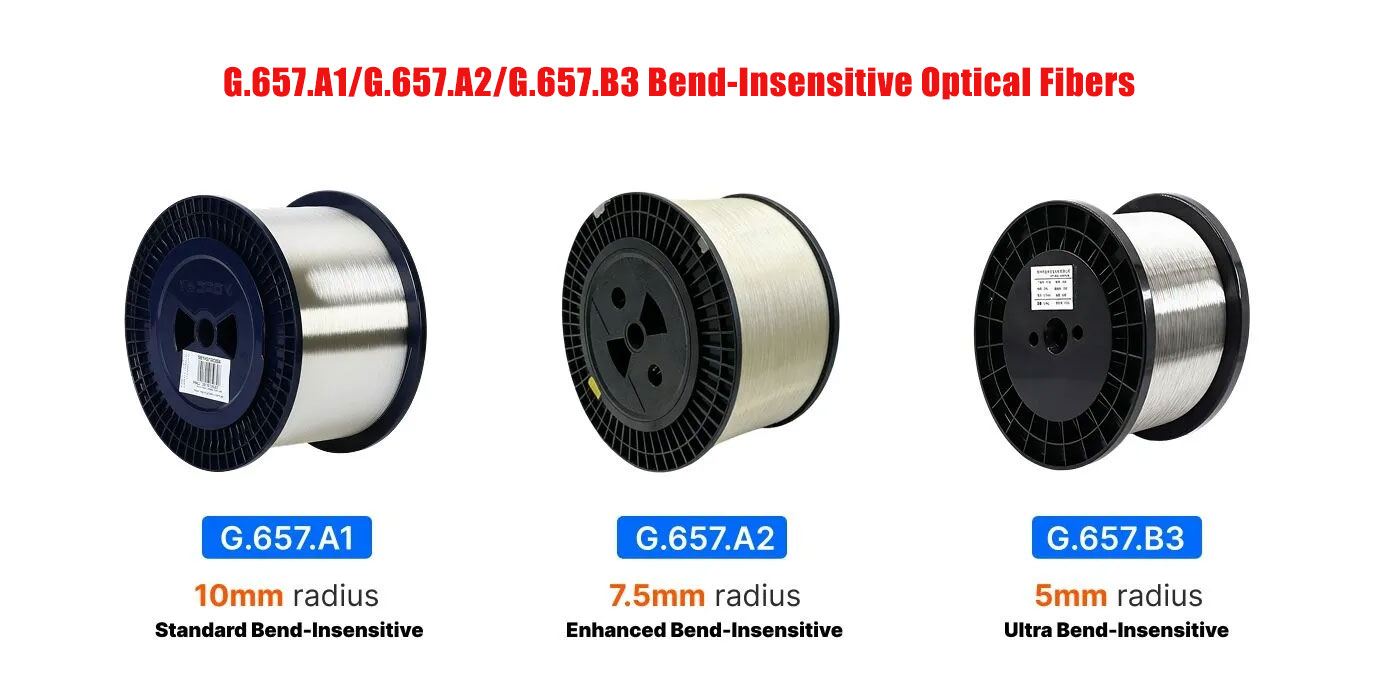
GL FIBER offers three grades of bend-insensitive optical fibers to meet diverse installation needs. G.657.A1 is the standard bend-insensitive fiber with a 10 mm minimum bend radius, fully compatible with G.652.D for general FTTH and indoor cabling. G.657.A2 delivers enhanced performance with a 7.5 mm bend radius, ideal for FTTH drop cables and high-density patching. G.657.B3 is the ultra bend-insensitive option, supporting an extreme 5 mm bend radius for space‑constrained applications such as micro‑ducts and drone tethers. All three maintain excellent signal integrity under tight bends while offering different levels of compatibility and flexibility. With 22 years of optical cable manufacturing expertise, GL FIBER provides customized solutions to match your project requirements.
Q1:What are the main differences between G.657.A1, G.657.A2, and G.657.B3 fibers?
A: The main difference is the minimum bending radius. G.657.A1 supports a 10 mm bend radius and is considered standard bend‑insensitive. G.657.A2 supports a 7.5 mm radius and is an enhanced bend‑insensitive fiber. G.657.B3 supports the tightest bend at 5 mm and is classified as ultra bend‑insensitive.
G.657.A1 is fully compatible with G.652.D, G.657.A2 also maintains good compatibility, while G.657.B3 offers the best bend performance but may require more care when splicing to standard fibers. At GL FIBER, we manufacture all three types with 22 years of experience.
Q2:Which G.657 fiber is fully compatible with G.652.D standard single‑mode fiber?
A: Both G.657.A1 and G.657.A2 are fully compatible with G.652.D. They share matching geometry, mode field diameter, and transmission characteristics, making splicing and integration into existing networks seamless. G.657.B3 has a slightly different mode field diameter, so while splicing is possible, it may introduce slightly higher loss. For most FTTH and legacy network upgrades, GL FIBER recommends G.657.A1 or G.657.A2.
Q3:What is the minimum bending radius of each fiber type?
A: G.657.A1 has a minimum bend radius of 10 mm.
G.657.A2 can bend down to 7.5 mm. G.657.B3 goes as tight as 5 mm. For comparison, standard G.652.D fiber typically requires about 30 mm. The 5‑mm capability of G.657.B3 is over six times tighter than standard fiber, enabling installation in extremely compact spaces.
Q4:What are the typical applications for these fibers?
A: G.657.A1 is commonly used in FTTH distribution networks, indoor building riser cables, and technical rooms. G.657.A2 is ideal for FTTH drop cables, terminals, multi‑dwelling unit wiring, patch panels, and high‑density racks. G.657.B3 is reserved for extreme‑space scenarios like high‑density patching, micro‑duct installations, drone tether cables, and other niche projects where ultra‑small bends are required. GL FIBER offers custom cables with any of these fiber types to suit your specific project.
Q5:Why choose bend‑insensitive G.657 fiber over standard G.652.D?
A: Bend‑insensitive G.657 fibers are designed for installations where cables must navigate tight corners, small conduits, or crowded enclosures. Unlike G.652.D, which suffers significant signal loss when bent sharply, G.657 maintains stable transmission even under severe bending. This makes installation easier, reduces the risk of performance degradation, and supports high‑density FTTH and data center architectures. With over two decades of cable manufacturing, GL FIBER ensures reliable G.657‑based products for critical networks.
Q6:Does
G.657.B3 have higher attenuation than A1 or A2?
A: Under straight or low‑bend conditions, all three types have similar attenuation, typically within the standard specification of 0.35 dB/km at 1310 nm and 0.23 dB/km at 1550 nm. However, when subjected to tight bends, G.657.B3 actually outperforms the A‑series because it is engineered to minimize bend‑induced loss at 5 mm. So the choice depends on your installation environment rather than just attenuation numbers. GL FIBER can help you select the best option.
Q7:Can G.657.A1 and G.657.A2 be spliced together?
A: Yes, absolutely. Both A1 and A2 belong to the same compatibility category and share similar geometric and optical parameters. Splice loss between them is very low and well within acceptable limits for most networks. Even splicing them to G.652.D is straightforward. At GL FIBER, we maintain strict quality control to ensure consistent splicing performance across all our fiber products.
Q8:Which G.657 fiber is best for FTTH drop cables?
A: G.657.A2 is the most widely recommended choice for FTTH drop cables because it offers a 7.5 mm bend radius to handle tight corners inside homes and multi‑dwelling units, and it is fully compatible with existing outside‑plant G.652.D networks. G.657.A1 can also be used for less demanding segments, while G.657.B3 is typically reserved for niche applications requiring 5 mm bending. GL FIBER produces FTTH drop cables with G.657.A2 as a standard, backed by 22 years of manufacturing expertise.
Q9:What is the practical difference between Category A and Category B G.657 fibers?
A: Category A fibers, which include A1 and A2, are designed for full compatibility with G.652.D. They have a mode field diameter in the range of 8.6 to 9.5 μm and are the mainstream choice for FTTH and general deployment. Category B fibers, such as B3, focus on maximum bend performance, with a mode field diameter that can be smaller (6.3 to 9.5 μm). While they offer the tightest bend radius, they may require careful splicing when connecting to standard fibers. Category B is best for specialized projects where bend performance is the top priority.
Q10:How do I choose the right G.657 fiber for my project?
A: For standard building cabling and technical rooms, choose G.657.A1. For FTTH drop cables, multi‑dwelling units, and tight patch panels, choose G.657.A2. For extreme‑density patching, micro‑ducts, or drone tethers, choose G.657.B3. If you need to splice to existing G.652.D networks, stick with A1 or A2. If maximum bend performance is your only concern, B3 is the way to go. If you are still unsure, GL FIBER’s technical team is ready to assist you with a free consultation based on your specific deployment needs.
GL FIBER – 22 Years of Optical Cable Manufacturing Excellence.



 ADSS Fiber Optic Cable
 OPGW Optical Ground Wire
 Bare Conductor
 Communication Optical Fibre
 Polarization-maintaining Fiber
 Aerial Fiber Cable
 Duct Fiber Cable
 Direct Buried Fiber Cable
 FTTH Drop Cable
 Air Blown Micro Cable
 Armored Fiber Optic Cable
 High Density Ribbon cable
 Biologically Protective Cable
 FTTX Tactical Cable
 Indoor Fiber Optic Cable
 Hybrid Fiber Optic Cable
 Fiber Optic Assemblies
 Company Profile
 Development History
 Qualification Honor
 Company Videos
 Exhibiting Overseas
 Our Solution