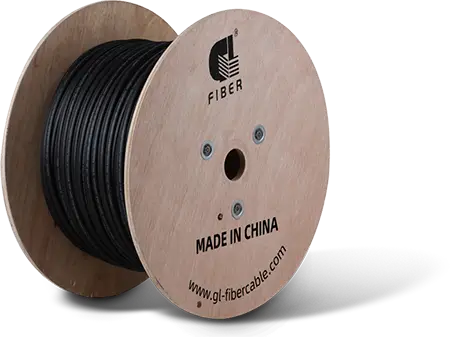
The global fiber optic industry is at an inflection point. For decades, solid-core fiber has been the backbone of communications. But as AI workloads and latency-sensitive applications multiply, traditional glass fiber is approaching its physical limits. Enter
hollow core fiber (HCF) – a technology that replaces the solid glass core with air, delivering transmission speeds approximately 31% faster than conventional single-mode fiber .
What Makes Hollow Core Fiber Different?
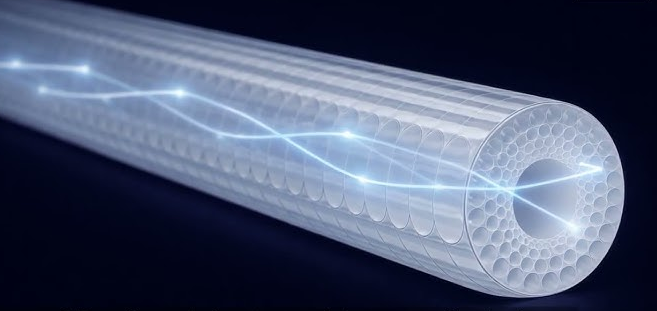
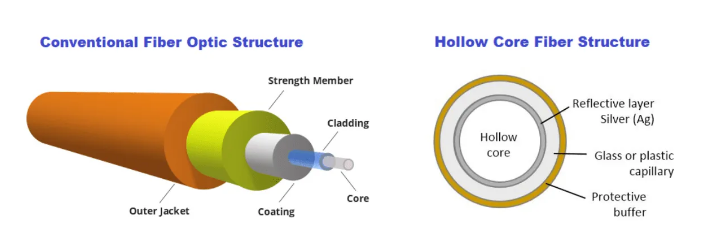
Unlike traditional fiber where light travels through silica glass,
hollow core fiber (HCF) guides light through an air-filled core. This fundamental difference unlocks extraordinary advantages:
Ultra-Low Latency: Light travels ~31% faster through air than glass, reducing latency from ~4.9 µs/km to ~3.33 µs/km . This 30%+ reduction is critical for AI training clusters and high-frequency trading.
Ultra-Low Attenuation: Advanced HCF has achieved attenuation as low as 0.05 dB/km at 1550nm – well below the 0.14 dB/km theoretical minimum for silica fiber .
Virtually Zero Nonlinearity: With >99% of light traveling through air, nonlinear effects are approximately 1,000 times lower than in solid-core fiber .
GL FIBER's Hollow Core Fiber Solutions
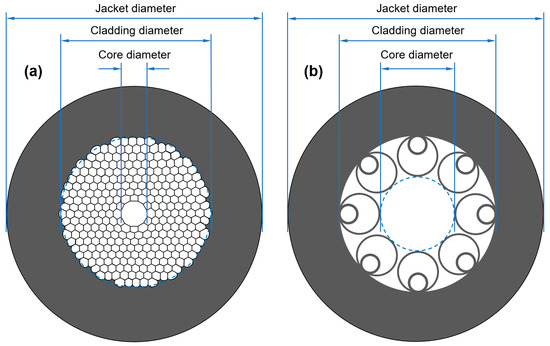
As a world-leading supplier of communication fiber products, GL FIBER has developed a comprehensive HCF portfolio leveraging independently synthesized raw materials and cutting-edge drawing processes. Our
HCF series includes:
Fiber Type
Transmission Window
Max Attenuation
Core Diameter
HCF-235/370-C+L
1530-1625 nm
0.5 dB/km
30±2 μm
HCF-235/370-O
1260-1360 nm
0.5 dB/km
30±2 μm
HCF-235/370-1μm
980-1100 nm
2 dB/km
30±2 μm
HCF-215/360-0.85μm
800-920 nm
1.4 dB/km
27±2 μm
HCF-325/460-2μm
1960-2120 nm
1.4 dB/km
40±2 μm
HCF-425/540-3μm
2820-3100 nm
62 dB/km
52±2 μm
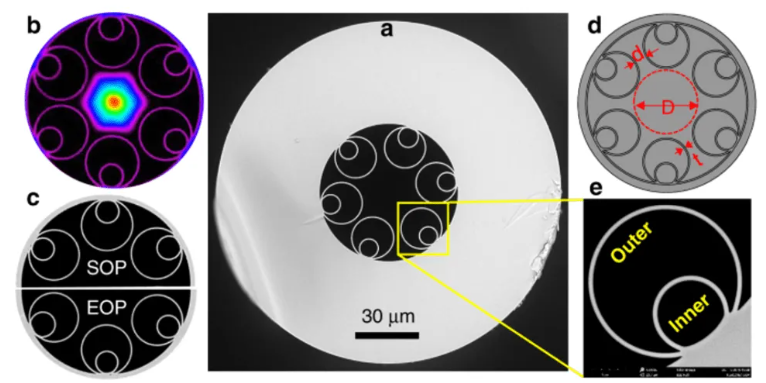
Key features:
-
Macro-bending loss ≤0.1 dB (D60-100 turns)
-
Dispersion coefficient: 3±3 ps/nm/km @1550nm
-
Customizable wavelengths, attenuation, and delivery length
Hollow Core Fiber Adapter: GL FIBER also offers HCF adapters designed to connect hollow core fibers with single-mode fibers, featuring ≤0.5dB insertion loss and ≥40dB return loss, enabling seamless integration into existing transmission systems.
Market Outlook: Why Hyperscalers Are Moving Now
The hollow core fiber market is experiencing explosive growth:
The global market was valued at $1.23 billion in 2025** and is projected to reach **$2.6 billion by 2030, growing at a CAGR of 16.1% .
The hollow-core fiber backbone network market is expected to grow from $0.72 billion in 2026 to $3.60 billion by 2031, at a CAGR of 37.97% .
Key players are already making moves:
Microsoft announced plans to deploy ~15,000 km of hollow core fiber across its Azure data centers .
Amazon Web Services began deploying HCF to connect data centers in 2025 .
China's YOFC has cumulatively delivered over 10,000 core-kilometers of HCF, achieving attenuation as low as 0.04 dB/km .
Applications Driving Demand
AI Data Centers & Computing Power Networks: AI clusters demand ultra-low latency – HCF reduces inter-GPU communication delays significantly.
High-Frequency Trading & Financial Networks: Every microsecond matters, and HCF delivers a competitive edge .
Quantum Transmission & Sensing: Low nonlinearity makes HCF ideal for quantum key distribution .
High-Power Laser Transmission: Higher damage thresholds enable industrial and medical applications.
Long-Haul & Subsea Communications: Lower attenuation enables longer repeater spacing.
Current Pricing Landscape
Hollow core fiber price remains a significant barrier to mass adoption. Current pricing is approximately $30,000/km, which is over 300 times the price of standard G.652.D fiber . However, as manufacturing scales and technology matures, costs are expected to decrease. Industry analysts note that hollow-core fiber commands a 20-30% premium over standard fiber types, with some estimates reaching nearly 1000 times the price of G.652.D .
For context, standard G.652.D fiber currently trades at $12-17/km, while G.657.A2 is at $26-33/km.
How to Evaluate Hollow Core Fiber Quality?
When sourcing HCF optical fiber, consider these factors:
1. Verify Attenuation Specifications
GL FIBER's HCF-235/370-C+L achieves ≤0.5 dB/km in the C+L band. Ensure your supplier provides verified batch-specific test data.
2. Check Bending Performance
Low macro-bending loss (≤0.1 dB) ensures reliable performance in real-world installations.
3. Confirm Wavelength Compatibility
Ensure the fiber's transmission window matches your application – from visible light to mid-infrared.
4. Assess Adapter Compatibility
GL FIBER's HCF adapters enable seamless connection to existing single-mode fiber systems. Verify insertion loss (≤0.5dB) and return loss (≥40dB) before purchase.
5. Partner with a Leader
GL FIBER leverages independently synthesized raw materials, precise capillary preparation, and cutting-edge drawing processes to achieve internationally leading performance levels and scale production.
Conclusion
Hollow core fiber represents the next frontier in optical transmission. With its unparalleled low latency, wide bandwidth, and low nonlinearity, HCF is poised to become the backbone of next-generation AI data centers, high-frequency trading networks, and advanced sensing systems. While hollow core fiber price remains premium today, the technology's transformative potential – combined with aggressive adoption by hyperscalers – points to accelerating market growth. As manufacturing scales, costs will decrease, making HCF accessible for broader applications.



 ADSS Fiber Optic Cable
 OPGW Optical Ground Wire
 Bare Conductor
 Communication Optical Fibre
 Polarization-maintaining Fiber
 Aerial Fiber Cable
 Duct Fiber Cable
 Direct Buried Fiber Cable
 FTTH Drop Cable
 Air Blown Micro Cable
 Armored Fiber Optic Cable
 High Density Ribbon cable
 Biologically Protective Cable
 FTTX Tactical Cable
 Indoor Fiber Optic Cable
 Hybrid Fiber Optic Cable
 Fiber Optic Assemblies

 Company Profile
 Development History
 Qualification Honor
 Company Videos
 Exhibiting Overseas
 Our Solution