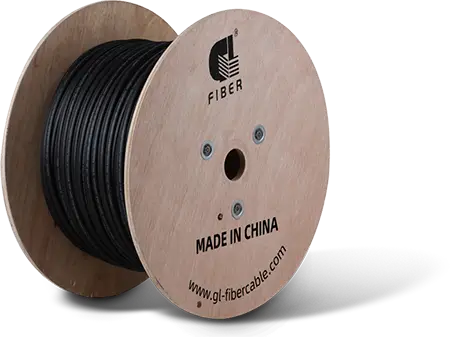
For decades, optical fiber has relied on a solid glass core to transmit light. But what if light could travel through air instead?
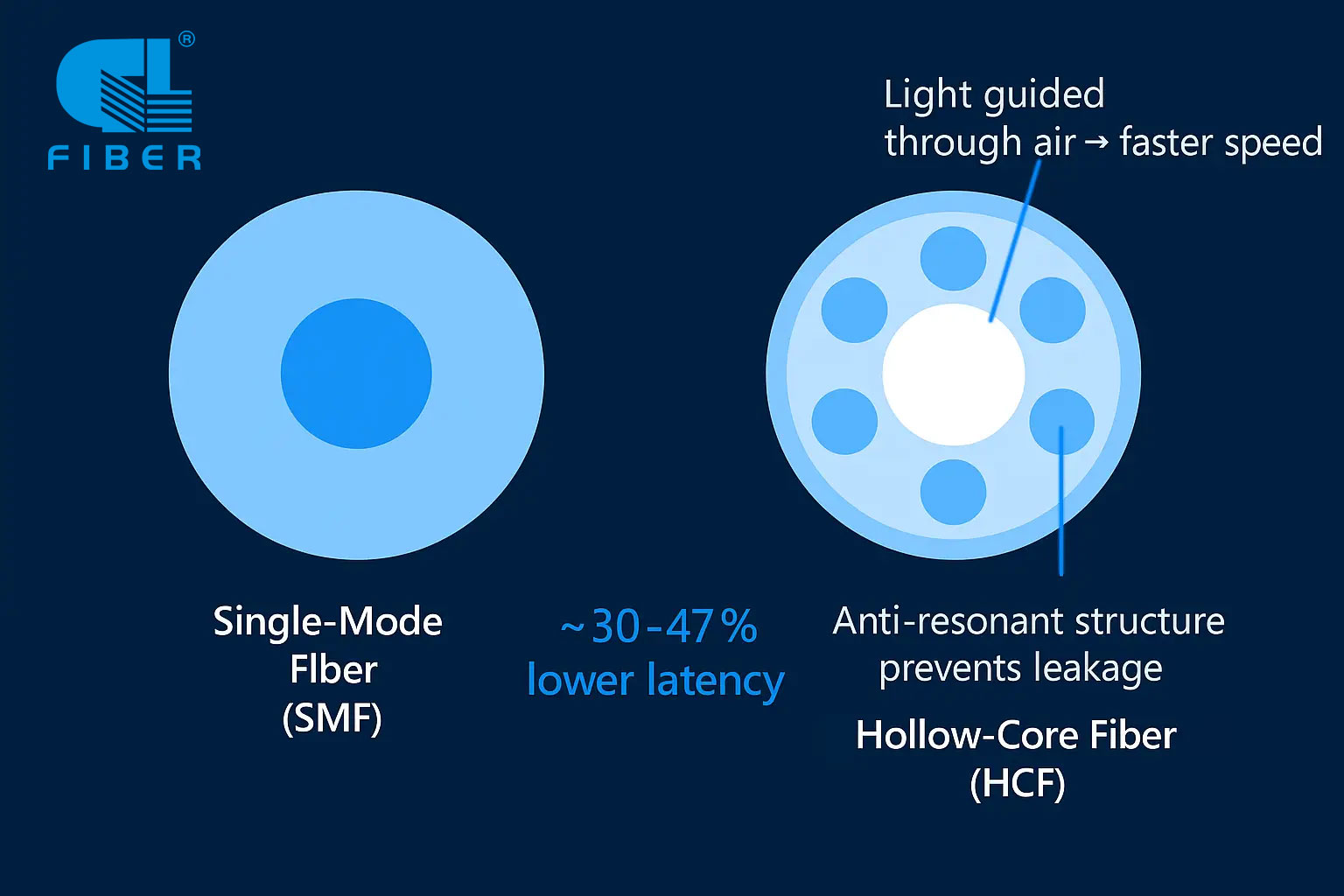
Hollow core fiber (HCF) is doing exactly that—and it is poised to reshape the future of high-speed communications. By replacing the traditional solid-glass core with an air-filled guiding structure, HCF delivers breakthrough performance in latency, loss, and nonlinearity that conventional single-mode fiber simply cannot match.
As AI data centers strain land, power, and latency budgets, hollow core fiber has emerged as a potential alternative to traditional optical fiber. This article provides a professional overview of HCF technology, its key parameters, applications, market trends, and procurement guidance from GL FIBER—a world-leading supplier of communication fiber products.
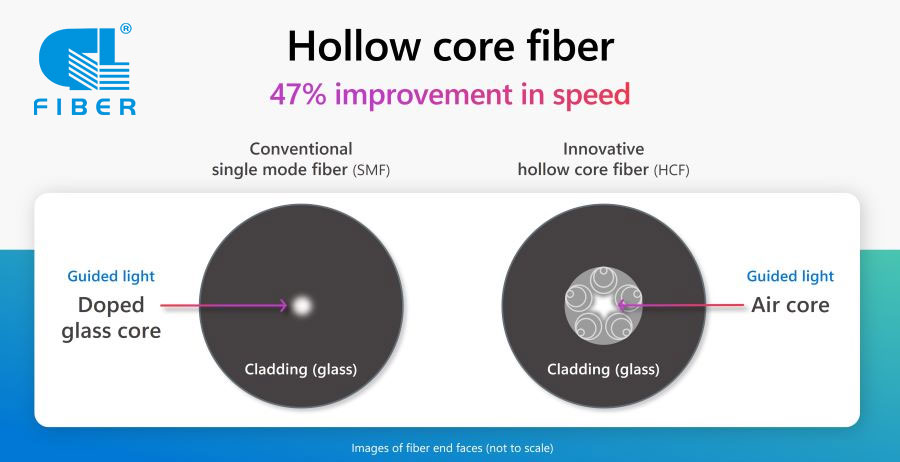
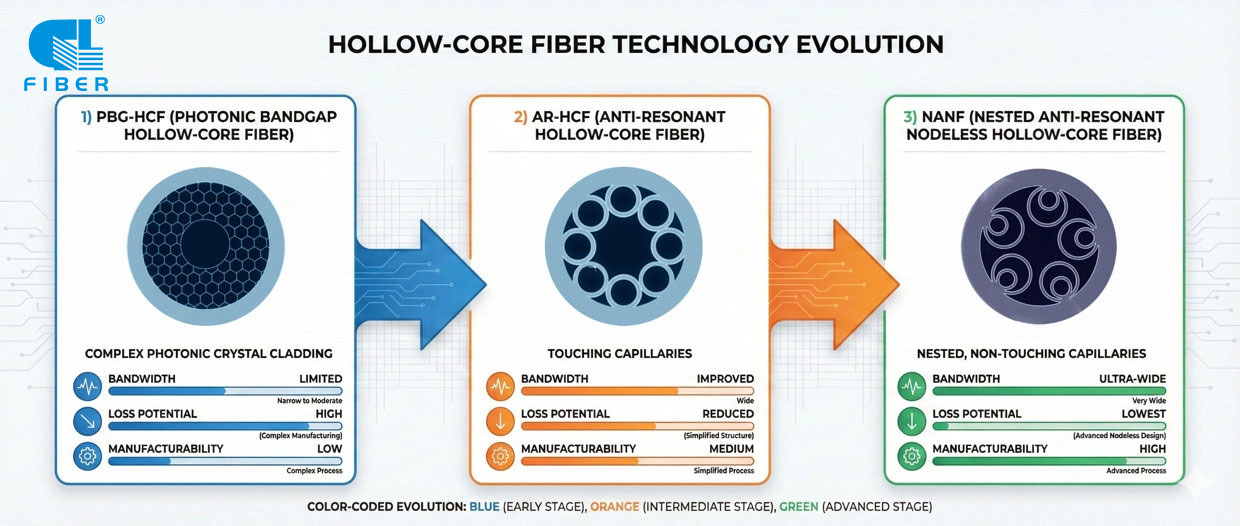
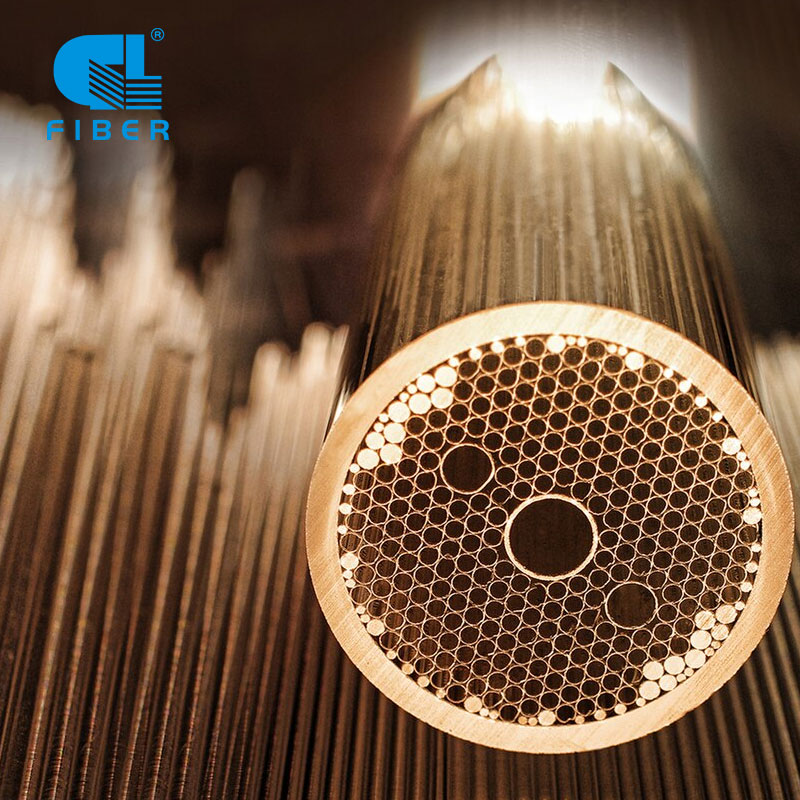
Hollow core fiber (also known as hollow-core anti-resonant fiber) features an air-guiding waveguide structure. Light travels through air rather than glass, fundamentally changing the physics of optical transmission.
HCF vs. Traditional Single-Mode Fiber
Parameter Hollow Core Fiber (HCF) Traditional Single-Mode Fiber
Transmission Medium Air-filled core Solid silica glass
Light Speed ~50% faster Slower (glass refractive index ~1.47)
Latency ~30% lower Higher
Nonlinearity Up to 3-4 orders of magnitude lower High
Transmission Loss As low as 0.04–0.11 dB/km Comparable or higher
Key Performance Parameters (GL FIBER HCF Series)
GL FIBER has developed a range of hollow core fibers suitable for wavelengths spanning from visible light to mid-infrared, achieving internationally leading performance levels and scale production.
GL FIBER HCF Product Specifications
Parameter HCF-235/370-C+L HCF-235/370-O HCF-235/370-1μm HCF-215/360-0.85μm
Transmission Window (nm) 1530-1625 1260-1360 980-1100 800-920
Max Attenuation (dB/km) 0.5 0.5 2 1.4
Core Diameter (µm) 30±2 30±2 30±2 27±2
Cladding Diameter (µm) 235±5 235±5 235±5 215±5
Coating Diameter (µm) 370±10 370±10 370±10 360±10
Macrobending Loss (dB) ≤0.1@1550nm ≤0.1@1310nm — —
Customization Available: HCF with other wavelengths, customized attenuation, and delivery lengths are available upon request.
HCF Adapter
GL FIBER also offers hollow core fiber adapters designed to connect
HCF with single-mode fibers. Featuring a modular packaging design, these adapters enable optical power coupling with low insertion loss and low return loss, allowing direct connection of HCF to existing transmission systems.
Key Advantages of Hollow Core Fiber
1. Ultra-Low Latency
Light travels nearly 50% faster in HCF than in traditional single-mode fiber, delivering approximately 30% lower transmission latency. For latency-sensitive applications like high-frequency trading, AI training, and real-time data processing, this is a game-changer.
2. Ultra-Low Nonlinearity
HCF exhibits up to 3-4 orders of magnitude lower nonlinearity than standard single-mode fiber. This enables higher launch power, higher optical signal-to-noise ratio (OSNR), and higher-order modulation formats.
3. Broad Transmission Bandwidth
HCF supports a wide low-loss spectrum, extending up to 2100nm, making it ideal for wavelength division multiplexing (WDM) and high-capacity transmission.
4. High Power Tolerance
HCF can carry up to 1,000 times more power than traditional fiber, enabling applications like power-over-fiber (PWoF) and high-power laser transmission.
Applications: Where Is HCF Being Deployed?
1. AI Data Centers
As AI data centers strain land and power resources, HCF has emerged as a potential alternative to single-mode optical fiber. Cloud providers are already deploying HCF at scale—AWS is connecting 10 data centers with HCF, and Microsoft is advancing global HCF deployment in the Azure network.
Key benefits for data centers:
Enables geographically distributed infrastructure
Reduces the number of edge data centers by up to 40%
Lowers network equipment cost by up to 38%
2. Long-Haul and Submarine Transmission
Recent demonstrations have achieved unrepeatered transmission over 726.1 km using HCF with EDFA amplification. HCF enables stable high-density WDM transmission with repeater spacing exceeding 160 km.
3. Quantum Communication
Quantum teleportation has been successfully demonstrated over HCF links on China Telecom's testbed, leveraging HCF's minimal latency and low dispersion.
4. High-Power Laser Transmission
HCF's ultra-low Rayleigh scattering, low dispersion, large effective area, and higher laser damage thresholds make it highly promising for high-power laser transmission and pulse compression.
5. Sensing and Specialty Applications
HCF is also used in gas sensing, ultraviolet to mid-infrared optical transmission, and industrial finance dedicated lines.
Market Trends: The HCF Market Is Accelerating
Market Size and Growth
The hollow-core fiber market is growing rapidly:
Market Segment 2025 Value 2026 Value 2031/2034 Forecast CAGR
Hollow-Core Fiber Market $1.23B $1.43B — 16.4%
HCF Backbone Network Market $0.58B $0.72B $3.60B (2031) 37.97%
Global HCF Market $68M — $112M (2031) 7.5%
HCF Optical Fiber Market $231.5M — $1.66B (2034) 24.44%
Commercial Deployment Accelerating
Longfei (YOFC) has cumulatively delivered over 10,000 km of HCF, achieving the lowest attenuation of 0.04 dB/km and the longest commercial line of 100 km, with over 13 commercial and pilot projects deployed globally.
AWS is deploying HCF to connect 10 data centers.
Microsoft is advancing global HCF deployment in the Azure network in collaboration with HUBER+SUHNER.
Prysmian is ramping up HCF production, with investments at its Eindhoven plant and successful production of a 24-fiber hollow core cable.
Price Trend
Unlike conventional fiber (
G.652.D) which has seen dramatic price increases of up to 650% due to AI-driven demand, HCF prices are actually declining as production scales up.
Recent procurement data shows HCF prices dropping from approximately 36,000 RMB per core-km (Guangdong Mobile) to approximately 20,000–25,000 RMB per core-km (Chongqing Wanzhou project). This downward trend is expected to continue as manufacturing processes mature and volumes increase.
Procurement Advice: What to Look for When Buying HCF
1. Verify Attenuation Performance
HCF attenuation varies significantly by wavelength window. GL FIBER's C+L band HCF achieves ≤0.5 dB/km—confirm the attenuation specification matches your application requirements.
2. Check the Transmission Window
Ensure the HCF's transmission window aligns with your operating wavelength. GL FIBER offers HCF for C+L band (1530-1625nm), O-band (1260-1360nm), 1μm, 0.85μm, 2μm, and 3μm.
3. Inspect Geometrical Properties
Core diameter, cladding diameter, and coating diameter must meet your connector and cabling requirements. GL FIBER provides detailed specifications for each fiber type.
4. Consider the HCF Adapter
HCF cannot be directly spliced to standard single-mode fiber. A high-quality HCF adapter is essential for integration into existing systems.
5. Partner with a Supplier with Scale Production Capability
HCF is still an emerging technology. Work with a supplier that has demonstrated scale production capability. GL FIBER has achieved internationally leading performance levels and scale production.
Why GL FIBER?
As a world-leading supplier of communication fiber products, GL FIBER is committed to the research and development of hollow core fiber series:
✅ Independently synthesized raw materials
✅ Precise size control capillary preparation process
✅ Cutting-edge drawing process for HCF
✅ Comprehensive solutions including HCF cables and HCF adapters
✅ Rapid response to diverse customer needs and batch delivery capability
✅ Customization for other wavelengths, attenuation, and delivery lengths
Conclusion
Hollow core fiber represents the most significant advancement in
optical fiber technology in decades. With its unparalleled advantages in latency, nonlinearity, and bandwidth, HCF is rapidly moving from research labs to commercial deployment—driven by the insatiable demands of AI data centers and next-generation networks.
As the market accelerates and prices continue to decline, now is the time to evaluate how hollow core fiber (HCF) can transform your network infrastructure.



 ADSS Fiber Optic Cable
 OPGW Optical Ground Wire
 Bare Conductor
 Communication Optical Fibre
 Polarization-maintaining Fiber
 Aerial Fiber Cable
 Duct Fiber Cable
 Direct Buried Fiber Cable
 FTTH Drop Cable
 Air Blown Micro Cable
 Armored Fiber Optic Cable
 High Density Ribbon cable
 Biologically Protective Cable
 FTTX Tactical Cable
 Indoor Fiber Optic Cable
 Hybrid Fiber Optic Cable
 Fiber Optic Assemblies
 Company Profile
 Development History
 Qualification Honor
 Company Videos
 Exhibiting Overseas
 Our Solution