For decades, the fiber optic industry has relied on
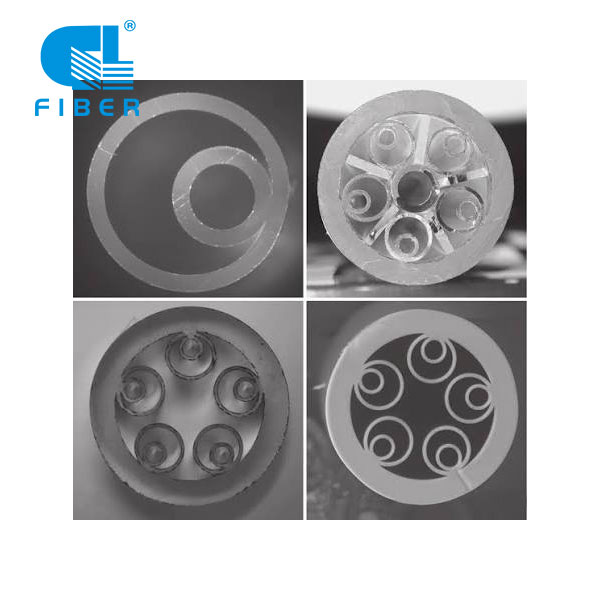
solid-core glass fibers to transmit light across the globe. But a paradigm shift is underway. Hollow core fiber (HCF) – also known as hollow-core anti-resonant fiber – is emerging as a revolutionary alternative, breaking away from traditional solid-core transmission mediums.
As a world-leading supplier of communication fiber products, GL FIBER is at the forefront of
hollow core fiber research and development. This article explains what hollow core fiber is, its key performance advantages, applications, market outlook, and what to look for when purchasing HCF products.
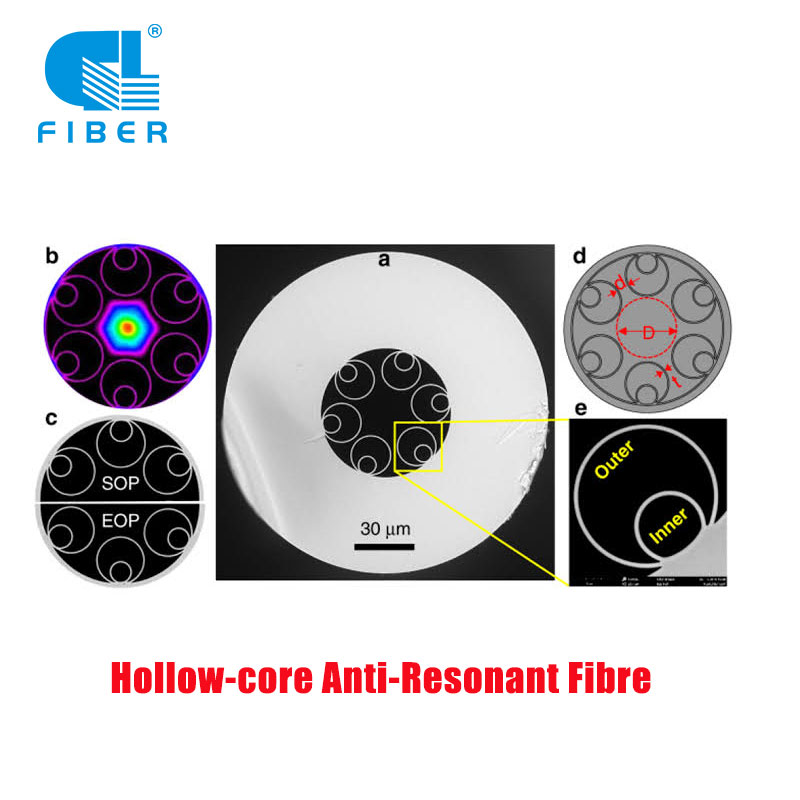
Unlike conventional optical fibers that guide light through a solid glass core,
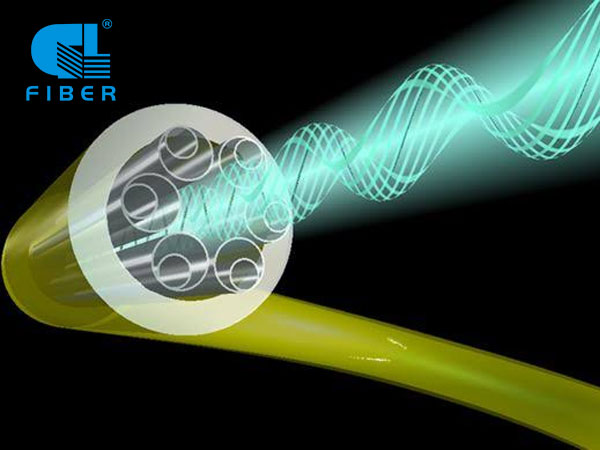
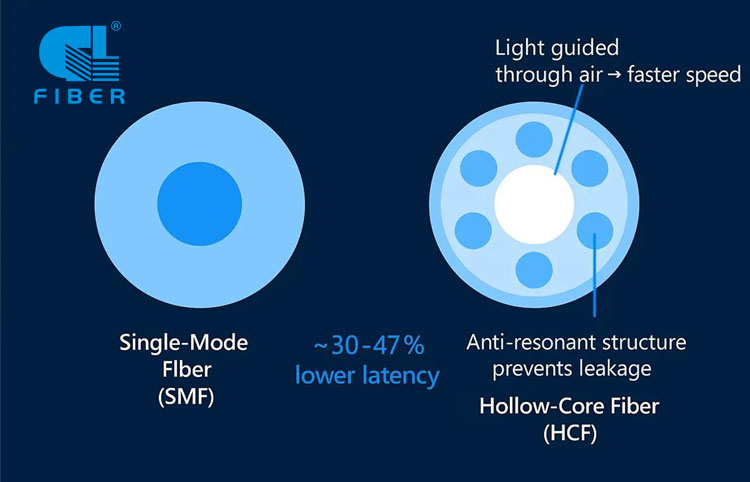
hollow core fiber features an air-guiding waveguide structure. Light travels primarily through air rather than glass, fundamentally changing the physics of optical transmission.
GL FIBER has developed a range of hollow core fibers suitable for wavelengths spanning from visible light to mid-infrared, achieving internationally leading performance levels and scale production. By leveraging independently synthesized raw materials, a capillary preparation process with precise size control, and a cutting-edge drawing process, GL FIBER ensures consistent quality and batch-to-batch reliability.
Key Performance Advantages of Hollow Core Fiber
Why is HCF generating so much excitement across the telecommunications and data center industries? The advantages are compelling:
Ultra-Low Latency
Because light travels faster in air than in glass (approximately 31% faster), hollow core fiber significantly reduces transmission latency. This is critical for high-frequency trading, AI data centers, and computing power networks where every millisecond counts.
Wide Transmission Bandwidth
Hollow core fiber offers an extremely wide transmission window, supporting high-capacity, high-speed optical transmission. This makes it ideal for next-generation networks demanding ever-increasing data throughput.
Low Loss & Low Nonlinearity
With ultra-low Rayleigh scattering, low dispersion, and a large effective area,
HCF minimizes signal distortion and enables longer transmission distances without regeneration.
High Power Handling
Hollow core fiber exhibits higher laser damage thresholds, making it highly promising for high-power laser transmission applications.
Broad Wavelength Coverage
From visible light to mid-infrared, hollow core fiber supports transmission across an exceptionally broad spectrum, enabling applications from quantum transmission to gas sensing.
Performance Parameters: GL FIBER's Hollow Core Fiber Portfolio
GL FIBER offers a comprehensive range of hollow core fibers with specifications tailored to different transmission windows.
HCF-235/370-C+L
Core Diameter: 30±2 µm
Cladding Diameter: 235±5 µm
Coating Diameter: 370±10 µm
Transmission Window: 1530-1625 nm
Max Attenuation: 0.5 dB/km
HCF-235/370-O
Core Diameter: 30±2 µm
Cladding Diameter: 235±5 µm
Coating Diameter: 370±10 µm
Transmission Window: 1260-1360 nm
Max Attenuation: 0.5 dB/km
HCF-235/370-1µm
Core Diameter: 30±2 µm
Cladding Diameter: 235±5 µm
Coating Diameter: 370±10 µm
Transmission Window: 980-1100 nm
Max Attenuation: 2 dB/km
HCF-215/360-0.85µm
Core Diameter: 27±2 µm
Cladding Diameter: 215±5 µm
Coating Diameter: 360±10 µm
Transmission Window: 800-920 nm
Max Attenuation: 1.4 dB/km
HCF-325/460-2µm
Core Diameter: 40±2 µm
Cladding Diameter: 325±5 µm
Coating Diameter: 460±10 µm
Transmission Window: 1960-2120 nm
Max Attenuation: 1.4 dB/km
HCF-425/540-3µm
Core Diameter: 52±2 µm
Cladding Diameter: 425±5 µm
Coating Diameter: 540±10 µm
Transmission Window: 2820-3100 nm
Max Attenuation: 62 dB/km
Key optical specifications:
Mode field diameter: 19.5–37 µm (wavelength-dependent)
Dispersion coefficient: 3±3 ps/nm/km (C+L and O bands)
Macro-bending loss: ≤0.1 dB (D60-100 turns)
Note: Hollow core fibers with other wavelengths can be customized. Both fiber attenuation and delivery length can be tailored to meet customer requirements.
Hollow Core Fiber Adapter: Bridging the Gap
A critical component of any HCF deployment is the hollow core fiber connector – specifically, the hollow core fiber adapter.
GL FIBER's hollow core fiber adapter is designed to connect hollow core fibers with
single-mode fibers. Featuring a modular packaging design, the adapter enables optical power coupling between hollow core fiber and single-mode fiber with low insertion loss and low return loss. This allows for direct connection of hollow core fibers to existing transmission systems, significantly enhancing user convenience.
Applications: Where Is Hollow Core Fiber Used?
The unique properties of HCF make it suitable for a wide range of applications:
-
Telecommunications & Data Centers
-
AI data centers – Low-latency interconnects for GPU clusters
-
Computing power networks – High-capacity, low-latency backbones
-
Dedicated lines for industrial finance – Ultra-low latency for high-frequency trading
-
Power & Energy
-
Electric power networks – Reliable, low-loss transmission for grid monitoring
Advanced Technologies
-
High-power laser transmission – Higher damage thresholds enable industrial laser applications
-
Ultraviolet to mid-infrared optical transmission – Broad wavelength coverage
-
Pulse compression – Ultra-fast laser systems
-
Quantum transmission – Low-loss, low-noise quantum communication
-
Gas sensing – Unique air-core structure enables interaction with gases
Hollow Core Fiber Price: What to Expect
As an emerging technology, hollow core fiber price varies significantly based on specifications, wavelength, attenuation requirements, and order volume.
Key factors affecting hollow core fiber pricing:
-
Transmission window – C+L band and O band fibers (lower attenuation) typically command premium pricing
-
Attenuation requirements – Lower loss (0.5 dB/km) fibers are more expensive to manufacture
-
Customization – Non-standard wavelengths or specialized coatings increase cost
-
Order quantity – Volume discounts apply for larger orders
-
Adapter requirements – Hollow core fiber connectors add to total system cost
GL FIBER Advantage: As a manufacturer with independently synthesized raw materials and proprietary drawing processes, GL FIBER offers competitive hollow core fiber pricing while maintaining internationally leading performance.
Market Trends: The Future of Hollow Core Fiber
The hollow core fiber market is poised for significant growth. Key trends driving adoption include:
AI Data Center Expansion
With AI infrastructure demanding ever-faster interconnects, HCF offers a clear latency advantage over traditional solid-core fiber. As data centers scale, the need for low-latency, high-bandwidth solutions will accelerate hollow core fiber adoption.
Telecommunications Infrastructure Upgrades
Telecom operators are exploring hollow core fiber for long-haul and submarine applications where the 31% speed advantage and lower nonlinearity can dramatically improve network performance.
Emerging Applications
Quantum communication, gas sensing, and high-power laser transmission are opening new markets for HCF beyond traditional telecommunications.
Manufacturing Scalability
As manufacturers like GL FIBER achieve scale production, hollow core fiber price is expected to become more competitive, accelerating market adoption.
How to Choose the Right Hollow Core Fiber?
When sourcing HCF for your project, consider these factors:
Define Your Transmission Window
Identify the wavelength range you need. GL FIBER offers fibers for C+L band (1530-1625nm), O band (1260-1360nm), 1µm, 0.85µm, 2µm, and 3µm windows.
Specify Attenuation Requirements
Determine the maximum attenuation your application can tolerate. Lower attenuation (0.5 dB/km) is ideal for long-distance transmission; higher attenuation may be acceptable for short-reach applications.
Consider the Connector Interface
Ensure you have the right hollow core fiber connector or adapter for your system. GL FIBER's hollow core fiber adapters enable seamless integration with existing single-mode fiber systems.
Evaluate Total System Cost
Factor in not just the hollow core fiber price but also the cost of connectors, adapters, and installation.
Partner with a Trusted Manufacturer
Work with a supplier that offers:
-
Proven manufacturing capability – GL FIBER has achieved scale production with internationally leading performance
-
Customization options – Attenuation and length can be tailored to your needs
-
Comprehensive solutions – Fiber, cable, and adapters from a single source
Why GL FIBER for Hollow Core Fiber?
-
GL FIBER is a world-leading supplier of communication fiber products, committed to the research and development of hollow core fiber series.
-
Independently synthesized raw materials – Full control over quality and consistency
-
Proprietary manufacturing process – Precise size control and cutting-edge drawing technology
-
Scale production capability – Internationally leading performance with batch delivery
-
Comprehensive solutions – Hollow core fiber cables and adapters available
-
Customization – Wavelength, attenuation, and length tailored to your requirements
Conclusion
Hollow core fiber (HCF) represents the next frontier in optical transmission. With its air-guiding waveguide structure, HCF delivers low latency, wide bandwidth, low loss, and low nonlinearity – advantages that are driving adoption across AI data centers, telecommunications, power networks, and emerging technologies like quantum communication.
Whether you need hollow core fiber for C+L band transmission, HCF for mid-infrared applications, or hollow core fiber connectors and adapters for system integration, GL FIBER has the expertise and manufacturing capability to meet your needs.
Ready to explore how hollow core fiber can transform your network? Contact GL FIBER today for specifications, pricing, and customization options.
Let GL FIBER shine all over the world. Light the world, one connection at a time.



 ADSS Fiber Optic Cable
 OPGW Optical Ground Wire
 Bare Conductor
 Communication Optical Fibre
 PM Fiber
 Aerial Fiber Cable
 Duct Fiber Cable
 Direct Buried Fiber Cable
 FTTH Drop Cable
 Air Blown Micro Cable
 Armored Fiber Optic Cable
 High Density Ribbon cable
 Biologically Protective Cable
 FTTX Tactical Cable
 Indoor Fiber Optic Cable
 Hybrid Fiber Optic Cable
 Fiber Optic Assemblies
 Company Profile
 Development History
 Qualification Honor
 Company Videos
 Exhibiting Overseas
 Our Solution