If your team is sourcing
bare optical fiber for drone programs, you have probably noticed the same pattern: quotations expire faster, delivery dates slip further, and suppliers who once welcomed small orders now ask about allocation.
G657A2 fiber has moved from a readily available component to a tightly managed resource.
This article examines what changed in 2026, what procurement teams should expect to pay, and how to structure purchases so that supply risk does not become project risk.
📊 From Buyer's Market to Seller's Market
For most of the past decade, optical fiber procurement followed a familiar rhythm: compare quotes, negotiate a few percentage points, place the order. That rhythm has broken down.
Three developments reshaped the balance of power:
First, AI infrastructure absorbed the slack. Data center fiber consumption reached roughly 69.6 million core-km in 2025 and is projected to exceed 100 million core-km in 2026. A single GPU cluster now demands several times the fiber of a conventional server hall.
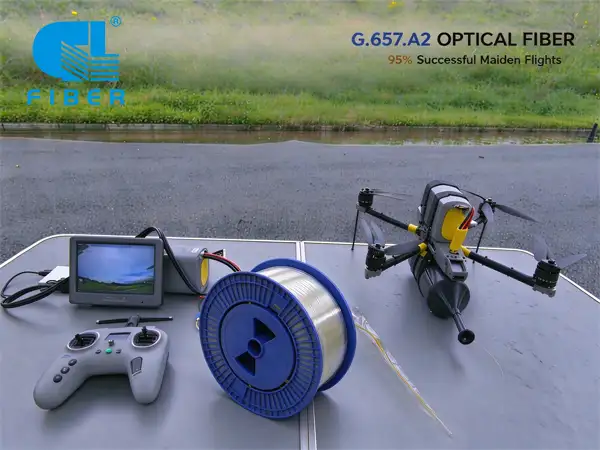
Second, drone programs created a consumable category. A fiber-guided FPV mission uses 10 to 40 kilometers of drone optical fiber per flight, and the fiber is not recovered. Combined Russian and Ukrainian consumption alone reached an estimated 50–60 million kilometers in 2025, with demand continuing into 2026.
Third, preform capacity could not respond quickly. Preforms represent roughly 70% of fiber production cost, and new capacity requires 18 to 24 months to commission. China's preform utilization already sits near 84%, leaving little room to absorb new orders.
The result: manufacturers are allocating rather than selling, and procurement teams are competing for production slots rather than negotiating unit prices.
📈 What Buyers Should Expect to Pay
Pricing for g657a2 fiber has repriced dramatically over the past eighteen months. The table below reflects the current range for standard drone-grade material:
Fiber Type
Approx. Price (RMB/core-km)
Approx. Price (USD/km)
Availability
G.657.A2 (0.25mm) 240–260 RMB $28–35/km Allocation-based
G.657.A1 120–150 RMB $17–20/km Limited but accessible
G.652.D 83–100 RMB $12–17/km Tight
Two data points illustrate how far the market has moved. China Mobile's September 2026 cable tender drew bids from all 17 qualified suppliers at the ceiling price, with average cable pricing up 90.46% versus the prior round. Meanwhile, major manufacturers report order books extending through Q1 2027.
For procurement teams, the practical implication is straightforward: the lowest credible quote is now a signal of supply reliability, not a bargaining win.
🛒 Procurement Strategies That Reduce Risk
1. Qualify Suppliers Before You Need Them
In an allocation market, responsiveness matters more than catalogue breadth. Establish technical contact with two or three manufacturers now—before a project deadline forces a rushed decision.
2. Ask for Batch-Level Documentation
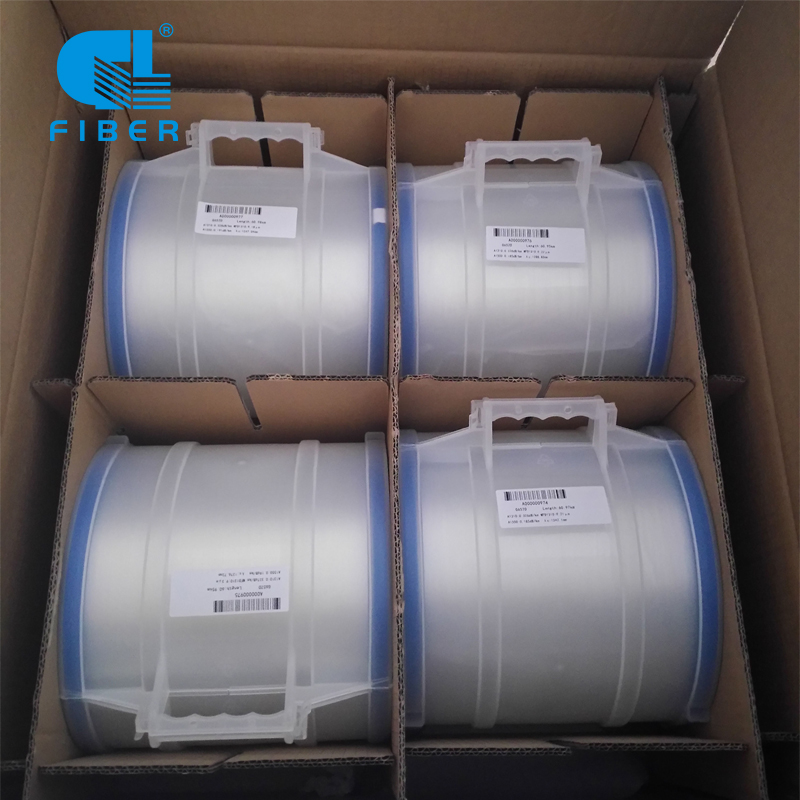
Legitimate suppliers provide test data tied to the specific spool being shipped. For 0.25mm bare fiber, the essential parameters are:
Parameter
Requirement
Minimum bend radius
7.5 mm
Macrobending loss (1550nm, 15mm radius, 10 turns)
≤ 0.03 dB
Coating diameter
235–245 μm
Proof test
≥ 9.0N, ≥ 1.0%
If a supplier offers only "typical values" or generic certificates, treat the quotation as unverified.
3. Plan Around 20-Week Lead Times
Lead times that once ran 8–12 weeks now extend to 20 weeks or more for fiber optic spool products. Procurement calendars should be built backward from installation dates, not forward from budget approval.
4. Lock Capacity, Not Just Price
A fixed unit price without a confirmed production slot offers little protection. Frame agreements that reserve monthly volume—even at prevailing prices—are more useful than spot orders chasing a lower number.
5. Treat Suspiciously Low Quotes as a Technical Question
When the market range for G.657.A2 is $28–35/km, an offer at $18/km is not a discount. It is either G.657.A1 relabeled, fiber that failed bend-loss screening, or material with unverified provenance. In drone applications, the failure mode appears in flight—not in incoming inspection.
🔒 Why Allocation Favors Direct Manufacturers
GL FIBER has manufactured optical fiber since 2004 and controls its own preform and drawing processes. That structure matters in a tight market for three reasons:
-
Production visibility – delivery commitments are made against actual line capacity, not hoped-for supply
-
Batch traceability – every spool is documented from preform through packaging
-
Consistency across orders – no dependence on third-party fiber of varying origin
For procurement teams that need predictable delivery more than the lowest headline price, working directly with a manufacturer removes an entire layer of uncertainty.
📞 Contact GL FIBER
If your team is planning drone fiber purchases for late 2026 or 2027, early technical discussions will help secure allocation. Reach out to review specifications, lead times, and volume planning.
Let
GL FIBER shine all over the world. Light the world, one connection at a time. 🌍



 ADSS Fiber Optic Cable
 OPGW Optical Ground Wire
 Bare Conductor
 Communication Optical Fibre
 Polarization-maintaining Fiber
 Aerial Fiber Cable
 Duct Fiber Cable
 Direct Buried Fiber Cable
 FTTH Drop Cable
 Air Blown Micro Cable
 Armored Fiber Optic Cable
 High Density Ribbon cable
 Biologically Protective Cable
 FTTX Tactical Cable
 Indoor Fiber Optic Cable
 Hybrid Fiber Optic Cable
 Fiber Optic Assemblies
 Company Profile
 Development History
 Qualification Honor
 Company Videos
 Exhibiting Overseas
 Our Solution