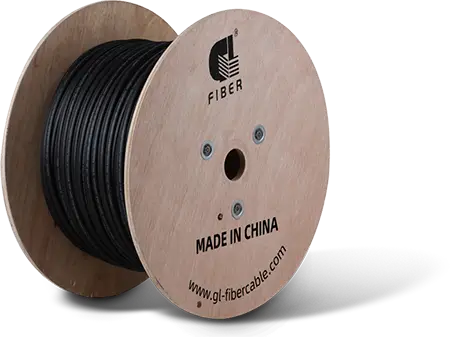
In the rapidly evolving world of drone technology, from First-Person View (FPV) racing to critical military and industrial missions, the demand for secure, high-bandwidth, and ultra-reliable communication links has never been greater. Traditional radio frequency (RF) systems face significant challenges, including signal interference, jamming, and bandwidth limitations. This is where advanced optical fiber technology steps in, offering a transformative solution. This guide explores how cutting-edge fiber optics, particularly our specialized 0.25mm drone-grade fiber, are powering the next generation of drone applications by enabling high-speed data transmission, enhanced electronic warfare immunity, and unmatched flight stability.
Understanding Optical Fibers for Drone Applications
At its core, a fiber optic drone system replaces the traditional wireless data link with a thin, durable optical fiber that unspools from the drone during flight. This fiber carries control signals to the drone and transmits high-definition video and sensor data back to the ground operator in real-time. The result is a communication channel that is virtually immune to electronic jamming and interception, a critical advantage highlighted by its increasing use in modern conflict zones. Furthermore, the high bandwidth of fiber supports the lossless transmission of complex data, which is essential for applications like detailed aerial mapping, industrial inspection, and immersive FPV experiences.
Key Fiber Standards: G.657.A2, G.657.A1, and G.652.D
Choosing the right fiber is paramount for performance and reliability. The market primarily utilizes standards defined by the International Telecommunication Union (ITU-T):
Fiber Standard Key Characteristics Primary Application in Drones & Networks
G.657.A2 Extremely bend-insensitive, superior microbend resistance, allows for very small coil diameters without signal loss. Ideal for compact, lightweight drone spools. FPV/Drone Fiber Optic Tethers, high-density access networks, space-constrained installations.
G.657.A1 Bend-insensitive, fully compatible with legacy G.652.D networks. Offers a good balance of performance and compatibility. Drone systems, fiber-to-the-home (FTTH) networks, building backbone cabling.
G.652.D The standard single-mode fiber for long-distance, high-speed backbone networks. Offers low attenuation but is less flexible than G.657 fibers. Long-haul terrestrial and submarine cables, core network infrastructure.
For drone applications,
G.657.A2 fiber is the unequivocal leader. Its exceptional bend-insensitivity ensures minimal signal degradation even when the fiber is tightly coiled on a small reel or bent around obstacles during flight. This property is crucial for maximizing flight range from a compact, lightweight payload.
Introducing GL-Fiber's Premier Drone Fiber Solution
To meet the specific demands of the UAV industry, GL-Fiber has engineered a state-of-the-art 0.25mm Diameter
G.657.A2 Optical Fiber. This product is the culmination of advanced material science and precision manufacturing, designed to directly address the core challenges of fiber-optic drone systems.
Technical Specifications & Advantages:
Ultra-Slim & Lightweight Design: With an outer diameter of just 0.25mm, our fiber offers a drastic reduction in weight and volume compared to standard fibers. This directly translates to longer flight times and increased payload capacity for drones, as less energy is spent carrying the tether itself.
Durable G.657.A2 Performance: Manufactured to the stringent ITU-T G.657.A2 standard, this fiber provides outstanding resistance to bending and microbending losses. This durability is essential for withstanding the dynamic stresses of flight, rapid deployment, and retrieval.
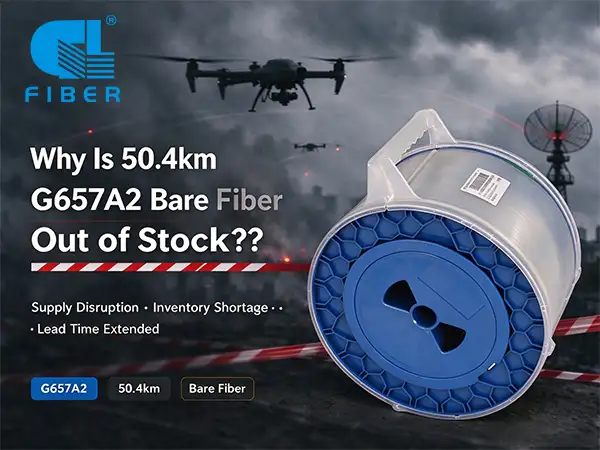
Extended Range Options: We offer this high-performance fiber on standard reels of
25.2km, 50.4km, and 60.4km, enabling drones to operate at significant distances while maintaining a flawless data link.
Full Customization Support: Understanding that every drone project is unique, we provide complete customization for fiber color (for easy identification), packaging, and reel lengths to seamlessly integrate with your specific system design.
Addressing the Challenges: From Theory to Reliable Operation
While the benefits are clear, practical deployment requires overcoming certain hurdles. Our fiber solution is designed to mitigate these common challenges:
Weight and Drag: The ultra-thin 0.25mm diameter is a direct response to the industry's need for lighter tethers, helping to minimize aerodynamic drag and payload strain.
Fiber Integrity & Durability: The robust G.657.A2 design ensures the fiber can tolerate the bends, twists, and potential abrasion encountered during complex maneuvers, reducing the risk of in-flight breakage.
Reel Mechanism Compatibility: The fiber's excellent bend performance and small diameter allow for smooth payout and retrieval on optimized reel mechanisms, which is critical for preventing tangles and ensuring stable flight.
Market Trends and Future Outlook
The convergence of several global trends is fueling massive demand for specialized optical fibers in the drone sector and beyond:
The Rise of the "Low-Altitude Economy": Drones are becoming central to logistics, emergency response, and infrastructure monitoring. This expansion demands reliable control links, especially in urban canyons or crowded RF environments, where fiber tethering provides a guaranteed connection.
Electronic Warfare and Secure Communications: The demonstrated effectiveness of fiber-optic drones in contested environments has spurred significant investment. The market for these jamming-proof systems is growing rapidly, with reports indicating supply chain constraints due to high demand.
Network Evolution Driving Fiber Innovation: The global push for denser, faster broadband networks is accelerating the adoption of bend-insensitive G.657 fibers. The G.652.D market remains strong for backbone networks, but G.657.A2 is becoming the go-to choice for advanced, space-sensitive applications. Innovations continue, with research pushing towards even smaller cladding diameters (e.g., 80µm) to pack more fiber into smaller cables, a trend that aligns perfectly with drone miniaturization.

Why Choose GL-Fiber for Your Drone Project?
Selecting GL-Fiber means partnering with a specialist who understands the intersection of fiber optics and unmanned systems. We don't just supply cable; we provide a high-performance, application-engineered solution that enhances the capability and reliability of your drone platform. Our 0.25mm G.657.A2 fiber is the critical link that enables you to achieve longer range, secure data, and mission success where conventional wireless systems fail.
Ready to integrate the future of drone connectivity? Explore our dedicated optical fiber solutions for communication systems and contact our technical team to discuss how we can customize a fiber package for your specific UAV or FPV application.



 ADSS Fiber Optic Cable
 OPGW Optical Ground Wire
 Bare Conductor
 Communication Optical Fibre
 Polarization-maintaining Fiber
 Aerial Fiber Cable
 Duct Fiber Cable
 Direct Buried Fiber Cable
 FTTH Drop Cable
 Air Blown Micro Cable
 Armored Fiber Optic Cable
 High Density Ribbon cable
 Biologically Protective Cable
 FTTX Tactical Cable
 Indoor Fiber Optic Cable
 Hybrid Fiber Optic Cable
 Fiber Optic Assemblies

 Company Profile
 Development History
 Qualification Honor
 Company Videos
 Exhibiting Overseas
 Our Solution