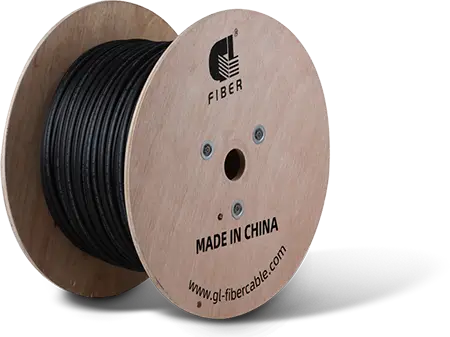
Polarization-maintaining (PM) fiber, also referred to as polarization-maintaining optical fiber, is engineered to preserve the polarization state of light as it travels through the fiber. In conventional single-mode fiber, random perturbations cause the polarization state to drift unpredictably. PM fiber solves this problem through deliberate birefringence, making it indispensable in fiber optic gyroscopes, interferometric sensors, and coherent laser systems.
This article explains how birefringence enables polarization maintenance, examines the Panda fiber design that dominates the market, and reviews applications and future prospects.
Why Standard Fiber Fails to Hold Polarization
An ideal circular-core single-mode fiber has two degenerate orthogonal polarization modes. Real fibers, however, are never perfect. Manufacturing tolerances and environmental factors—bending, temperature swings, mechanical stress—break the symmetry. The result is random birefringence, causing the polarization state to evolve unpredictably along the fiber length.
For most telecom links, this is harmless. For interferometric sensing or coherent detection, it is a critical failure mode. Signal fading, measurement drift, and reduced accuracy all stem from uncontrolled polarization evolution.
Engineered Birefringence: The Core Mechanism
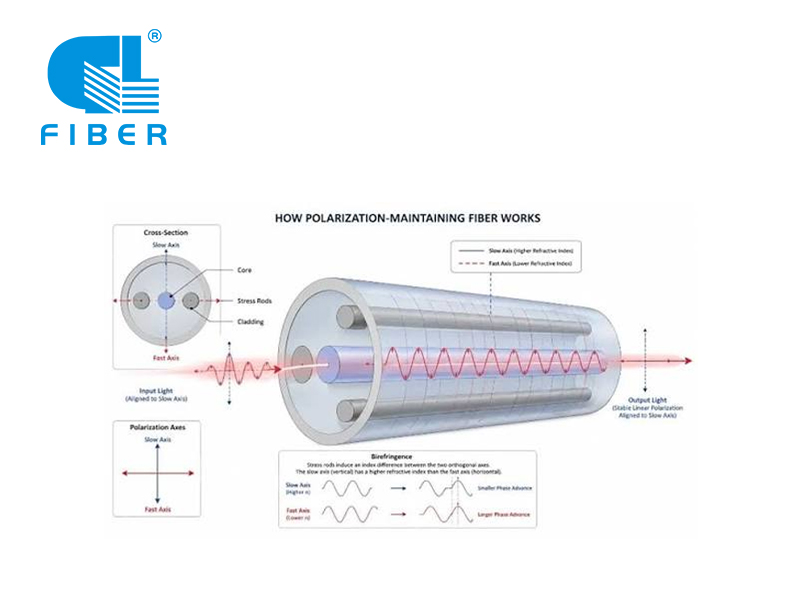
PM fiber does not suppress birefringence. Rather, it introduces a strong, permanent, and precisely controlled birefringence during fabrication. This intentional birefringence overwhelms any random perturbation, effectively locking the polarization state into one of two principal axes.
The critical parameter is beat length—the distance over which the two polarization modes accumulate a 2π phase difference. A shorter beat length means stronger birefringence and tighter polarization holding. High-quality PM fiber achieves beat lengths in the millimeter range, whereas random perturbations in standard fiber occur over much longer, uncontrolled scales.
When light is launched aligned with one principal axis, it stays on that axis. Cross-coupling to the orthogonal axis—quantified as crosstalk or polarization extinction ratio (PER)—is minimized.
Panda Fiber: The Dominant Stress-Induced Design
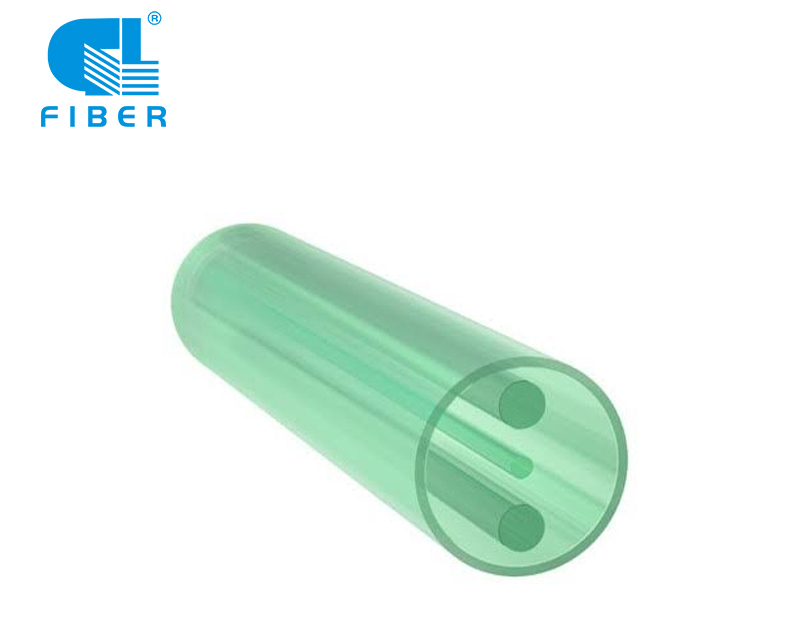
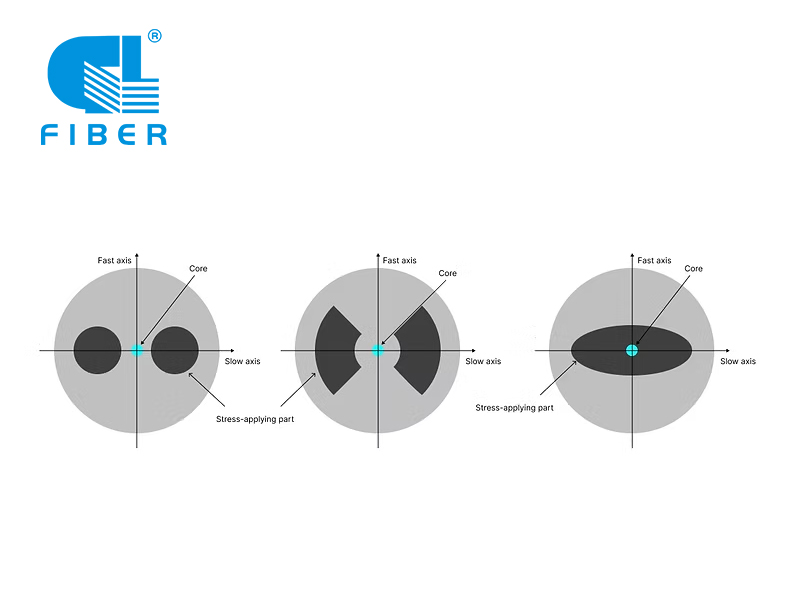
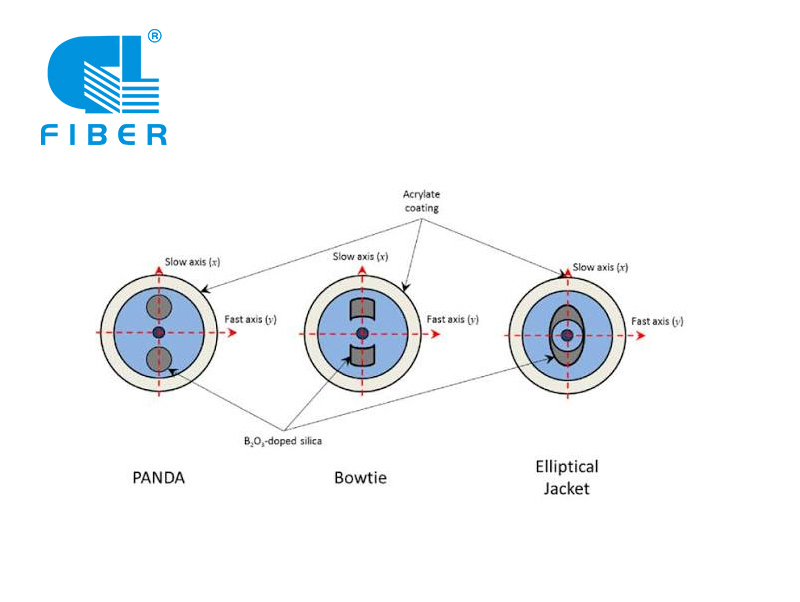
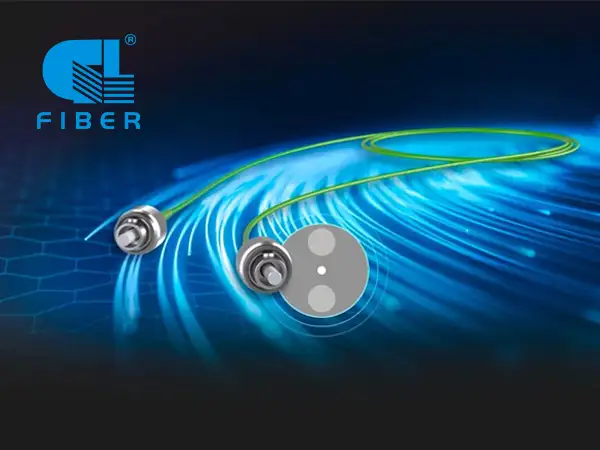
Among PM fiber architectures, Panda fiber is the most widely produced and deployed. Its name comes from the cross-sectional appearance: two circular stress rods flank the core, resembling panda eyes.
How Panda Fiber Generates Birefringence?
Panda fiber creates birefringence through thermal stress, not geometric asymmetry alone. The stress rods are typically boron-doped silica with a thermal expansion coefficient different from the surrounding cladding. During fiber drawing and cooling, this mismatch generates anisotropic stress in the core region.
The stress breaks the symmetry of the core's refractive index: one transverse axis has a higher index (slow axis), the other a lower index (fast axis). The resulting birefringence is stable, reproducible, and largely immune to external perturbation—exactly what PM fiber requires.
Panda fiber's advantages include mature fabrication processes, excellent PER, and good compatibility with standard single-mode fiber in mode-field diameter and attenuation—making it the preferred choice for telecom-adjacent applications and fiber gyroscopes.
Advanced PCVD process technology enables precise geometric control and consistent birefringence across production batches.
Key Performance Metrics
Metric Significance
Extinction Ratio (PER) Ratio of power in the primary axis to leakage in the orthogonal axis; higher is better
Beat Length Shorter beat length indicates stronger birefringence and tighter polarization holding
Crosstalk Power coupled from one axis to the other; lower (more negative dB) is better
Attenuation Optical loss; PM fiber should match standard single-mode fiber where compatibility matters
These parameters determine whether a PM fiber suits a given application. Fiber gyroscopes demand high PER and low crosstalk; laser delivery systems prioritize power handling and bending performance.
Application Areas
Fiber Optic Gyroscopes (FOGs)
The largest application segment for PM fiber. FOGs use PM fiber coils to sense rotation via the Sagnac effect. Polarization stability directly determines measurement accuracy—any drift introduces bias error. Panda fiber is the dominant choice in this market.
Fiber Optic Sensors and Lasers
Interferometric sensors, hydrophones, and current sensors rely on PM fiber to maintain coherent interference between signal and reference arms. In fiber lasers, PM fiber preserves linear polarization for stable amplification and frequency conversion.
Telecom Components
PM fiber is used in polarization-sensitive components: couplers, splitters, modulators, and isolators. The rise of coherent transmission and CPO (co-packaged optics) architectures is creating new demand for PM fiber in data center interconnects.
Emerging Applications
Commercial aerospace, quantum photonics, and biomedical imaging systems increasingly specify PM fiber where polarization control is non-negotiable.
Market Outlook
The global PM fiber market is projected to grow from USD 305 million in 2025 to USD 794 million by 2033, at a CAGR of 12.7%. Growth drivers include:
-
Defense and aerospace modernization: Fiber gyroscope demand remains steady across navigation and guidance systems.
-
AI data center infrastructure: CPO and near-packaged optics require polarization-stable fiber connections between laser sources and optical engines.
-
Industrial laser expansion: Fiber laser penetration in cutting, welding, and additive manufacturing continues to rise.
-
Sensor proliferation: Distributed acoustic sensing and structural monitoring increasingly adopt PM fiber solutions.
Panda fiber remains the dominant product type by volume, with bow-tie and elliptical designs serving niche high-birefringence requirements.
Conclusion
PM fiber(
Polarization-maintaining Fiber) maintains polarization through engineered birefringence—a deliberate, permanent asymmetry that overwhelms random environmental perturbations. Panda fiber, with its stress-rod design, remains the most mature and widely deployed solution. As applications expand from fiber gyroscopes into AI data center interconnects and advanced sensing, demand for high-performance PM fiber continues to grow.



 ADSS Fiber Optic Cable
 OPGW Optical Ground Wire
 Bare Conductor
 Communication Optical Fibre
 Polarization-maintaining Fiber
 Aerial Fiber Cable
 Duct Fiber Cable
 Direct Buried Fiber Cable
 FTTH Drop Cable
 Air Blown Micro Cable
 Armored Fiber Optic Cable
 High Density Ribbon cable
 Biologically Protective Cable
 FTTX Tactical Cable
 Indoor Fiber Optic Cable
 Hybrid Fiber Optic Cable
 Fiber Optic Assemblies
 Company Profile
 Development History
 Qualification Honor
 Company Videos
 Exhibiting Overseas
 Our Solution