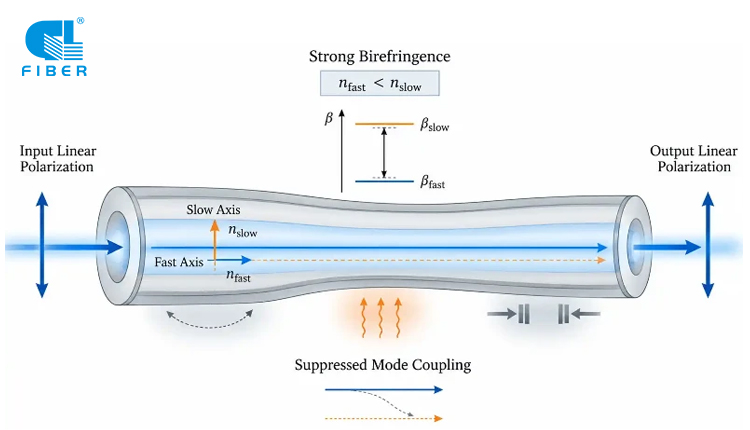
Polarization-maintaining (PM) fiber preserves a stable linear polarization by doing something that may sound counterintuitive: it deliberately introduces strong, well-defined birefringence. Rather than attempting to make the fiber perfectly symmetric, PM fiber creates two orthogonal polarization eigenmodes with different effective refractive indices and propagation constants.
This built-in difference is far larger and more controlled than the weak, random birefringence that ordinary fiber can acquire from bending, residual stress, temperature changes, or manufacturing imperfections. When the input polarization is aligned with one of the fiber's principal axes, unwanted coupling into the orthogonal polarization mode is strongly suppressed.
At
GL FIBER, we manufacture PM fiber using advanced PCVD process technology, delivering ultra-high extinction ratio, low crosstalk, and short beat length for the most demanding polarization-sensitive applications.
What Is Polarization-Maintaining Fiber?
PM fiber is a specialty optical fiber designed to maintain the orientation of linearly polarized light. It is typically a single-mode fiber with a deliberately asymmetric stress or geometry profile.
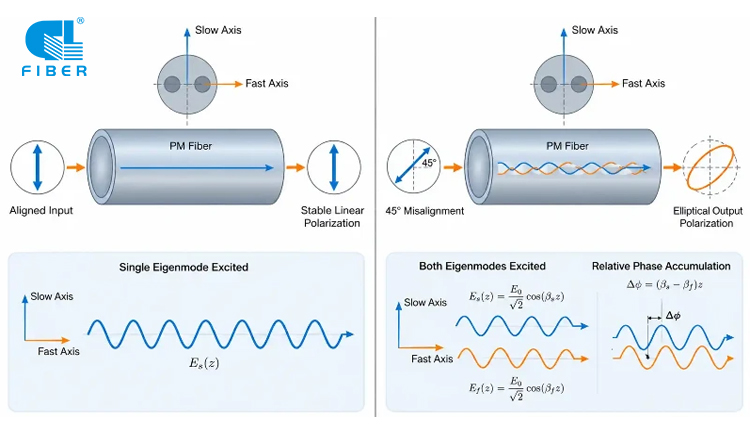
PM fiber does not preserve every arbitrary input polarization state. Its most reliable operating condition is obtained when linearly polarized light is launched along one of its two principal birefringent axes. Those axes are commonly called the fast axis and the slow axis.
How Strong Birefringence Prevents Polarization Coupling?
The key physical idea is not that environmental stress is always "too weak" to affect the fiber. Rather, strong birefringence creates a large difference between the propagation constants of the two orthogonal polarization eigenmodes. Because their relative phase changes rapidly along the fiber, ordinary slowly varying perturbations are poor at coupling optical power coherently from one eigenmode into the other.
Stronger birefringence produces a shorter beat length, making typical long-scale disturbances less effective at driving mode coupling.
Fast Axis and Slow Axis
The two principal polarization axes have different effective refractive indices. The axis with the lower effective refractive index is the fast axis because its phase velocity is higher, while the axis with the higher effective refractive index is the slow axis.
If the input electric field is aligned with either axis, ideally only one polarization eigenmode is excited. With little power in the orthogonal mode, the launched linear polarization remains stable as it propagates.
Polarization Beat Length
The polarization beat length is the distance over which the two polarization eigenmodes accumulate a relative phase shift of 2π. For a wavelength λ and effective index difference Δn, it can be written as:
Lb = λ / |Δn|
For a given wavelength, a larger birefringence corresponds to a shorter beat length. Beat length is therefore a useful engineering indicator of how strongly the two polarization modes are separated.
GL FIBER's PM fiber products are engineered to deliver short beat length, ensuring superior polarization maintenance across a wide range of operating conditions.
How Is Birefringence Built Into PM Fiber?
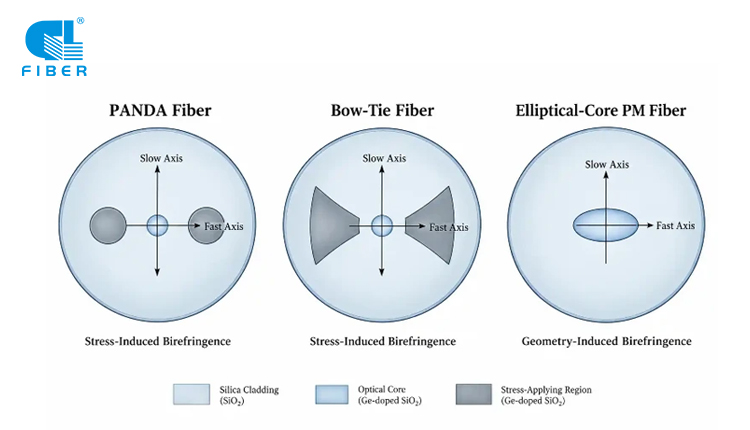
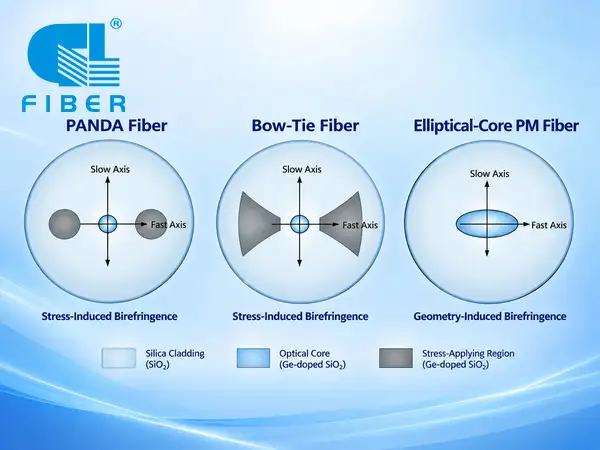
Two common design approaches are stress-induced birefringence and geometry-induced birefringence. Both create a stable difference between the effective refractive indices of the two orthogonal polarization modes.
Stress-Induced Birefringence: PANDA and Bow-Tie Fiber
In stress-induced PM fiber, specially designed stress-applying regions are placed around the core. In PANDA fiber, two stress-applying parts are positioned on opposite sides of the core. These regions commonly use glass compositions with thermal-expansion properties different from the surrounding silica.
As the fiber cools after drawing, the mismatch in thermal contraction creates a controlled residual stress field across the core. Through the photoelastic effect, that stress produces different refractive indices along two orthogonal directions. Bow-tie fiber uses a different stress-region geometry to achieve the same basic goal: stable, strong linear birefringence.
Geometry-Induced Birefringence: Elliptical-Core Fiber
Another approach is to make the core itself asymmetric, such as an elliptical core. The geometric asymmetry changes the boundary conditions seen by the two orthogonally polarized modes, producing different effective refractive indices even without relying on the same stress-rod arrangement used in
PANDA fiber.
The result is again a pair of well-defined polarization eigenaxes that can maintain a launched linear polarization when the input is aligned correctly.
GL FIBER offers a comprehensive PM fiber product line:
Product Type
Description
Application
Conventional PM Fiber
Baseline models for general applications
Fiber gyroscopes, sensing systems
Bending Insensitive PM Fiber
Suitable for small bend radius applications
Compact optical modules
Small Mode Field PM Fiber
For specialized components
Precision sensing
Reduced Diameter PM Fiber
For miniaturized devices
Dense packaging
What Happens If the Input Polarization Is Misaligned?
If light is launched at an angle to the principal axes, the input field decomposes into components along both eigenmodes. Both modes then propagate simultaneously and accumulate phase at different rates.
At a 45° launch angle, for example, the two axes are excited with comparable field amplitudes. The relative phase between them changes with propagation distance and can also respond to wavelength and environmental changes. The output may therefore become elliptical or rotate rather than remaining in the original linear state.
This is why PM systems require rotational alignment not only at the launch point but also at connectors and splices. Axis misalignment at a joint can transfer energy into the unwanted polarization state.
How Is PM Fiber Performance Measured?
Several parameters are useful when specifying or evaluating a PM fiber system:
Parameter
Definition
Significance
Birefringence (Δn)
Effective refractive-index difference between the two principal polarization modes
Higher Δn means stronger polarization maintenance
Beat Length
Distance required for 2π relative phase accumulation between the two modes
Shorter beat length indicates stronger birefringence
Polarization Extinction Ratio (PER)
Measure of optical power remaining in the desired polarization relative to the orthogonal polarization
Higher PER indicates better polarization purity
Polarization Crosstalk
Amount of unwanted power coupled from the launched eigenaxis into the orthogonal eigenaxis
Lower crosstalk (more negative dB) indicates superior performance
Axis Alignment
Rotational accuracy between input polarization, fiber axes, connector keying, and splice orientation
Critical for maintaining polarization through the entire optical path
GL FIBER's PM fiber products deliver ultra-high extinction ratio, low crosstalk, and excellent geometric control, ensuring reliable performance in the most demanding applications.
Where Is Polarization-Maintaining Fiber Used?
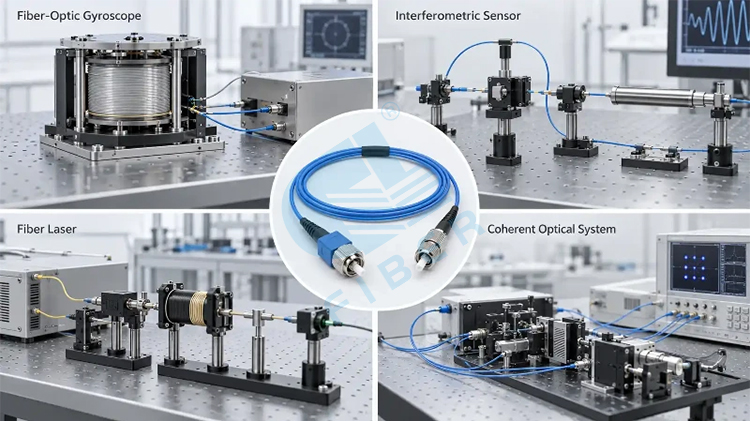
PM fiber is used when uncontrolled polarization drift would reduce measurement accuracy, interfere with modulation, or destabilize an optical system. Typical applications include:
1. Fiber-Optic Gyroscopes
This is the largest application market for PM fiber, accounting for approximately 51% of total demand. Fiber gyroscopes are core sensors in aerospace, missile guidance, and satellite attitude control systems. PM fiber performance directly determines gyroscope accuracy.
2. Interferometric Sensors
Used in fiber hydrophones, ocean exploration, and sonar systems, PM fiber ensures the stability of interference signals.
3. Coherent Optical Systems
PM fiber is essential for maintaining polarization stability in coherent detection and modulation schemes.
4. Laser Delivery and Fiber Lasers
In high-power laser systems, PM fiber is used to transmit and amplify polarized light.
5. Polarization-Sensitive Test Equipment
PM fiber ensures accurate measurements in laboratory and production testing environments.
6. AI Data Centers (Emerging Growth)
In next-generation optical interconnect architectures such as CPO (Co-Packaged Optics) and NPO (Near-Packaged Optics), PM fiber is used for connections between optical engines and external laser sources. This is a current market hotspot with significant growth potential.
PM Fiber vs. Standard Single-Mode Fiber
Standard single-mode fiber guides one spatial mode but still supports two orthogonal polarization states. Small random birefringence along ordinary fiber can cause the state of polarization to evolve unpredictably with temperature, bending, and stress.
PM fiber also commonly operates in a single spatial mode, but its deliberately strong birefringence separates the two polarization eigenmodes enough to reduce coupling between them. This is the essential reason PM fiber can maintain a selected linear polarization while ordinary single-mode fiber generally cannot guarantee the same polarization orientation at its output.



 ADSS Fiber Optic Cable
 OPGW Optical Ground Wire
 Bare Conductor
 Communication Optical Fibre
 PM Fiber
 Aerial Fiber Cable
 Duct Fiber Cable
 Direct Buried Fiber Cable
 FTTH Drop Cable
 Air Blown Micro Cable
 Armored Fiber Optic Cable
 High Density Ribbon cable
 Biologically Protective Cable
 FTTX Tactical Cable
 Indoor Fiber Optic Cable
 Hybrid Fiber Optic Cable
 Fiber Optic Assemblies
 Company Profile
 Development History
 Qualification Honor
 Company Videos
 Exhibiting Overseas
 Our Solution