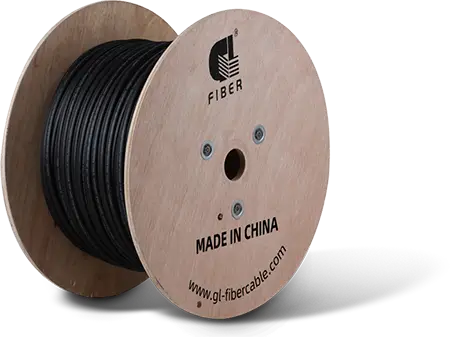
PM fiber, short for Polarization-Maintaining Fiber, is a specialty optical fiber designed to maintain the polarization state of light as it travels through the fiber. Unlike conventional single-mode fiber, PM fiber uses controlled birefringence to reduce unwanted coupling between two orthogonal polarization modes.
Because stable polarization is important in many precision optical systems,
Polarization-Maintaining Optical Fiber is widely used in fiber optic gyroscopes, fiber lasers, optical sensors, interferometers, LiDAR, coherent optics, and other advanced photonics applications.
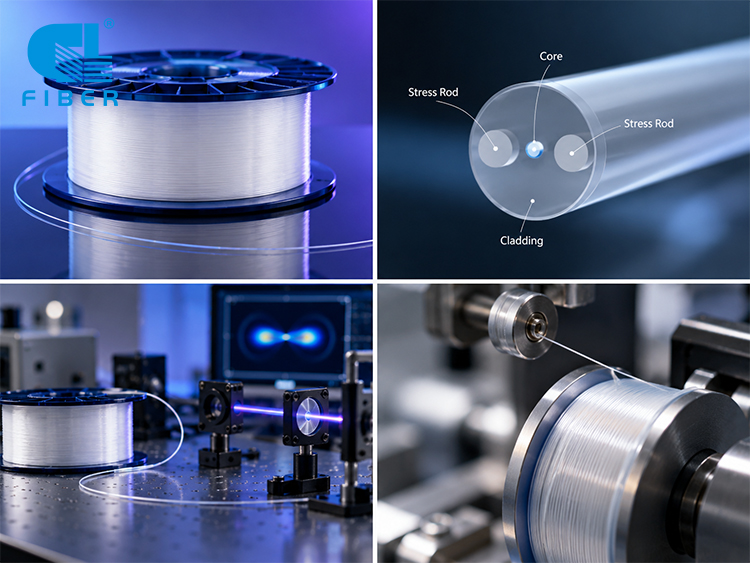
How Does PM Fiber Work?
The operating principle of PM fiber is based on birefringence.
A PM fiber is designed with two principal polarization axes, commonly known as the fast axis and slow axis. When polarized light is aligned with one of these axes, the fiber's strong birefringence helps prevent energy from transferring to the other polarization mode.
This makes the polarization state much more stable compared with standard single-mode fiber.
The polarization-maintaining performance of a fiber is commonly evaluated using parameters such as:
Polarization Extinction Ratio (PER)
Beat Length
Birefringence
Attenuation
Mode Field Diameter (MFD)
These parameters should be considered together when selecting PM fiber for a specific optical system.
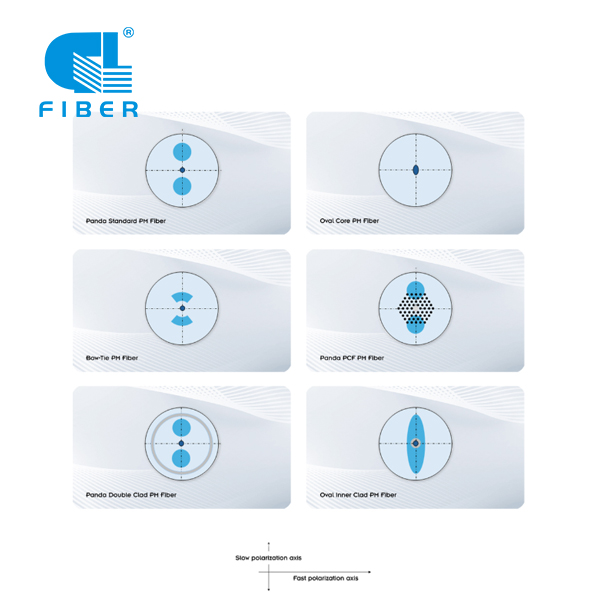
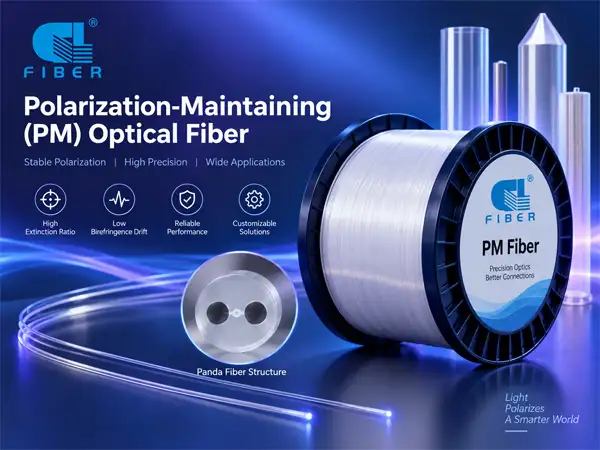
PANDA fiber is one of the most common structures used for polarization-maintaining fiber.
The name comes from its distinctive cross-sectional design. Two stress-applying regions are positioned on opposite sides of the fiber core. During the manufacturing process, these regions introduce controlled stress around the core, generating strong birefringence.
This structure creates stable polarization axes and helps reduce polarization coupling.
PANDA fiber is commonly used in:
-
Fiber optic gyroscopes
-
Fiber lasers
-
Optical sensors
-
Interferometers
-
Optical modulators
-
LiDAR systems
-
Precision optical instruments
PANDA is therefore a specific type of PM fiber, while PM fiber is the broader category.
 The main difference between PM fiber and conventional single-mode fiber is polarization control.
Standard single-mode fiber can support two polarization states, but environmental factors such as bending, vibration, temperature changes, and mechanical stress can cause polarization fluctuations.
PM fiber introduces controlled birefringence to significantly reduce this polarization coupling.
Therefore, standard single-mode fiber is generally suitable for conventional optical transmission, while Polarization-Maintaining Fiber is preferred when stable polarization is an important part of system performance.
The main difference between PM fiber and conventional single-mode fiber is polarization control.
Standard single-mode fiber can support two polarization states, but environmental factors such as bending, vibration, temperature changes, and mechanical stress can cause polarization fluctuations.
PM fiber introduces controlled birefringence to significantly reduce this polarization coupling.
Therefore, standard single-mode fiber is generally suitable for conventional optical transmission, while Polarization-Maintaining Fiber is preferred when stable polarization is an important part of system performance.
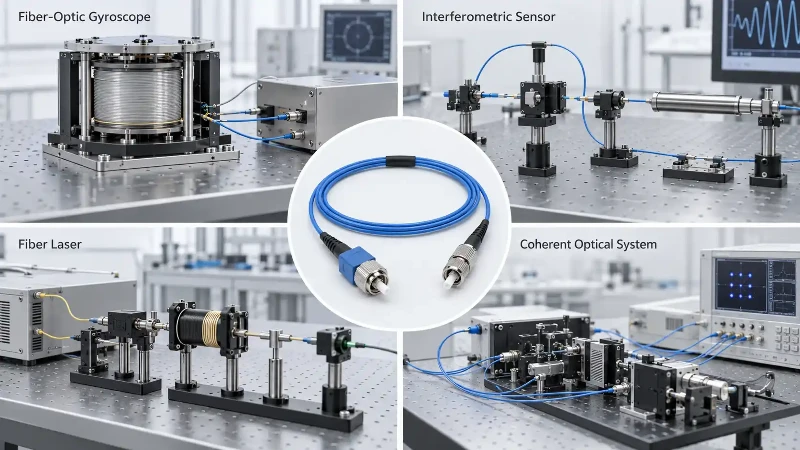
PM fiber is used in many advanced optical technologies.
Fiber Optic Gyroscopes
Fiber optic gyroscopes rely on precise optical interference to measure rotation. Stable polarization helps improve the consistency of the optical signal and is an important part of many FOG designs.
Fiber Lasers
PM fiber can help maintain a predictable polarization state in fiber laser systems, making it suitable for polarization-sensitive laser architectures.
Optical Sensing
PM fiber is used in precision sensing and interferometric systems where changes in polarization can affect measurement accuracy.
LiDAR and Photonics
Modern LiDAR and photonic systems may require controlled polarization for optical signal generation, transmission, and detection. PM fiber provides a stable polarization path between optical components.
Quantum and Coherent Optical Systems
Polarization can be an important parameter in quantum photonics and coherent optical technologies, making PM fiber useful for selected high-precision applications.
How to Choose PM Fiber ?
When selecting PM optical fiber, consider the following specifications:
-
Operating wavelength – Make sure the fiber matches the laser or optical system.
-
Polarization Extinction Ratio – Important for evaluating polarization purity.
-
Beat Length and Birefringence – Indicate the strength of polarization maintenance.
-
Mode Field Diameter – Important for efficient coupling with other optical components.
-
Attenuation – Determines the optical loss of the fiber.
-
Fiber structure – PANDA, Bow-Tie, and other designs provide different characteristics.
-
Coating and environmental performance – Important for temperature, mechanical, and long-term reliability requirements.
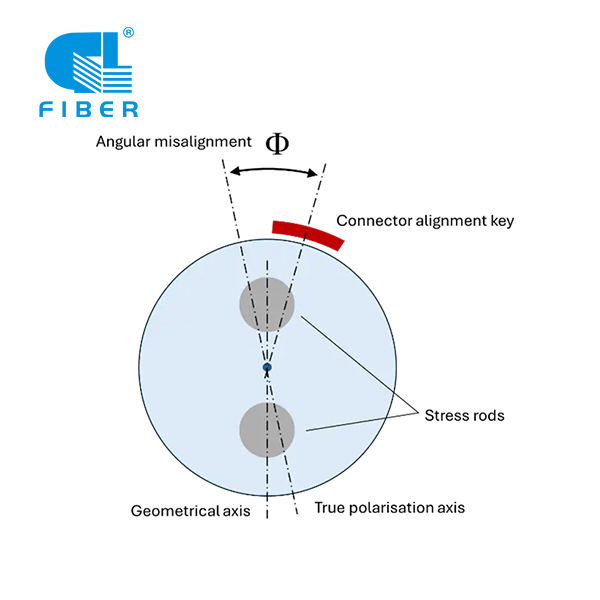
For PM fiber assemblies, correct axis alignment is also critical. Poor alignment during splicing or connectorization can reduce the polarization-maintaining performance of the finished assembly.
Conclusion
PM fiber, or Polarization-Maintaining Fiber, is designed to provide stable and predictable polarization propagation through controlled birefringence. PANDA fiber is one of the most widely used PM fiber structures, using stress-applying regions to create strong birefringence around the core.
From fiber optic gyroscopes and fiber lasers to optical sensing, LiDAR, and advanced photonics, Polarization-Maintaining Optical Fiber provides an important solution for applications where polarization stability matters.
When choosing PM fiber, engineers should consider wavelength, PER, birefringence, beat length, attenuation, MFD, fiber structure, and axis alignment to ensure compatibility with the target optical system.



 ADSS Fiber Optic Cable
 OPGW Optical Ground Wire
 Bare Conductor
 Communication Optical Fibre
 Polarization-maintaining Fiber
 Aerial Fiber Cable
 Duct Fiber Cable
 Direct Buried Fiber Cable
 FTTH Drop Cable
 Air Blown Micro Cable
 Armored Fiber Optic Cable
 High Density Ribbon cable
 Biologically Protective Cable
 FTTX Tactical Cable
 Indoor Fiber Optic Cable
 Hybrid Fiber Optic Cable
 Fiber Optic Assemblies
 Company Profile
 Development History
 Qualification Honor
 Company Videos
 Exhibiting Overseas
 Our Solution